In the podcast, I put in the wrong link for the Show Notes. Here is the correct one.
Monday, December 04, 2006


My Three Shrinks Podcast 1: Podcasting Makes You Potty

So we finally did our first podcast after talking about it for a month. It's about 25 minutes long and can be found here [
Yes, the theme is ripped from the 1960's TV sitcom, My Three Sons, even down to the re-done logo and theme song (Clink wanted us to do Put Down the Duckie, but it just didn't seem to fit in well... maybe in a later one.)
Can you figure out which shrink is which?
So, here are the show notes for the podcast:
December 3, 2006: Podcasting Makes You Potty
[click the .m4a file to download]- Tip of the hat to Leo Laporte's This Week in Tech (TWiT) podcast for inspiration
- Also a nod goes to Dr Dave Van Nuys at shrinkrapradio.com, who kindly pointed out he was doing a Psychology podcast of the same name way before us. Check it out, it's very well done
- Dr Anonymous is not mentioned even once in this podcast
- 60 Minutes: Beta-blockers to prevent PTSD and reduce traumatic memories?
- Cardiac risk after post-heart attack depression
- Shrink Rap Post: Go Red for Women
- NHSBlogDoc's John Crippen's post about England's idea of requiring psychiatric evaluations for hospice and "assisted dying" patients
| [Update: You can now subscribe to My Three Shrinks on iTunes, or download the .mp3] technorati tags:shrinkrap, podcast, psychiatry, psychiatrist, depression, heart, attack, PTSD, propranolol, hospice Blogged with Flock |
Sunday, December 03, 2006
Just a Little Misery

Dr. John Crippen (not his real name) over at NHSBlog talked yesterday about the proposal for mandatory psychiatric evaluations on all patients admitted for hospice care. Regarding a cancer patient, he writes:
He goes on to ask:Of course he is bloody well down. He is about to depart from life. He is about to leave his wife and children. Forever. He knows this. He is not just down. He is seriously pissed off. Dying is an unpleasant business. Best avoided. But, if you have to do it, do not expect it to be fun or a clap-happy "learning experience."
Do patients with cancer suffer from severe depression? Of course they do. Occasionally. And when they do, they need help, and support and possibly medication. But this is a rare occurrence. Patients ingrownowing toe nails get depression too, but you are not going to attach a psychiatrist to every chiropody clinic. Are you?If this trend continues, we will end up imposing a psychiatrist on every patient with cancer. Unnecessary, patronising and offensive.
I was thrilled to think of myself, in my professional capacity, as being "attached" to chiropody clinics, "imposed" on patients, and a referral for my services is "unnecessary, patronising and offensive." Great. What more could my image want?
One of his commenters talks about his cat's death and asks facetiously, "We were all a bit miserable....Do we need psychiatric help?"
I posted about this topic a while back. See Help Me If You Can, where I wrote about my childrens' comments that their classmates go to therapy for a year when their parents get divorced. It's all part of the same line of questioning: Does one NEED therapy (or medications or any other psychiatric intervention) when bad things happen, be it cancer, grief, divorce? Treatment may help those who do become depressed following a stressor: half of all patients suffering from an episode of depression will identify a clear precipitant. Treatment may help those who are reacting in a dysfunctional, unusual, or highly symptomatic way. Treatment may offer a degree of comfort to distressed people even in the absence of mental illness. But does everyone who is exposed to awful circumstances NEED treatment? Nope. Some times life is just hard and there's no escape from suffering. It's hard to know what to say to this: Grief runs its course, people generally adapt to difficult circumstances, but it's hard to say Don't Get Help, when really, some folks find it helps.
Shiny Happy Person returned this weekend, and she writes one of the most eloquent descriptions of depression, as opposed to simple misery, that I have ever seen:
Utterly miserable is what a lot of people mistake for depression, but they are not the same thing. God, I should know.
Depression is both the most godawful, visceral agony, and a numbness so overwhelming you can't imagine ever feeling real again. It is an inability to feel or be affected by anything other than your own intense pain. It is frostbite of the mind. It is that dream where you want to scream but no sound
comes out. Depression is the feeling of walking through glue, both physically and mentally, which reflects in the effort it takes to open your mouth to speak. Depression paints the world monochrome and muffles all sounds. Depression strips away your personality and leaves you two-dimensional. Normal human functioning diminishes; sleep dwindles to nothing, food becomes an alien notion, weight falls from your bones in a physical representation of your character and the person you have forgotten you used to be. Depression is crawling on hands and knees to get to the bathroom; it is lying in bed and wondering if you would be able to move if the house was on fire. It is trying to carry out a familiar activity and not having the first clue what to do.
Saturday, December 02, 2006
Hanlon's Razor
 After years of work in correctional healthcare I've decided that there are a certain number of universal truths. I've confirmed these by talking to numerous colleagues over the years who work in a variety of pretrial and sentenced-side facilities in many jurisdictions. Here they are:
1. There is a direct correlation between the amount of time it takes to get through a locked gate and your need to reach the bathroom on the other side of the gate.
2. When you reach the bathroom there will be no toilet paper.
3. Physicians will not be allowed to park in the spot assigned to the warden's secretary.
4. The parole paperwork will be lost for the inmate you most want to get out of your facility.
5. If one inmate doesn't get transported to your clinic it will be the inmate who just got out of the forensic hospital.
6. If an inmate is going to decompensate it will happen at shift change on Friday afternoon.
7. Physicians will not be allowed to park in the spot assigned to the maintenance supervisor.
8. The solution to every problem will be a new state-mandated form, in triplicate.
9. If there is one working elevator it will be the one that is forbidden for civillian use.
10. If there is only one nurse on duty it will be the one who does not speak English.
11. Physicians will not be allowed to park in any spot assigned to the transportation unit.
12. The adage called Hanlon's Razor will remain true:
"Never attribute to malice that which can be adequately explained by stupidity."
Friday, December 01, 2006
Where have all the bloggers gone?
More, specifically, where have all the Shrink bloggers gone?
First, we lost Shrinkette, gone on to do bigger and better and perhaps less addictive things with her time.
Shiny Happy Person I'm hoping is just on a little leave, trying to get her shininess or happiness back in sync? A psychiatrist-in-training in the UK, I love her insights, love her direct, sometime brash, way of telling it like it is. I miss her comments and the regular hair reports. I, by the way, am back to very curly with fewer chemicals.
FooFoo5-- his exact title remains unknown, and we Shrink Rappers thought for the longest time that he was a forensic psychiatrist, now we seem to think he's a social worker, but he was ClinkShrink's blog friend, working on the inside, and whatever he is, I love his insights. He, too, disappears without warning and long ago stopped his regular comments. Foo's been kind enough to post his status as Not-Able-To-Comment, compliments of Beta Blogger.
The Last Psychiatrist is still out there, and still says things that aggravate me. He doesn't always post my comments, so I've been less excited about composing them.
I've tried unsuccessfully to engage Dr. Crippen on the NHS Blog, and Flea, neither of whom seem to want to be engaged. KevinMD, I think, doesn't know the Shrink Rappers exist. It sort of reminds me of how psychiatrists in general tend to feel disregarded by other MD's, though I hesitate to say such things--Fat Doctor and Dr. A visit regularly.
The Shrink Rappers remain in blog-o-land happily posting. What's new on the horizon? Roy is wrapped around the idea of a PodCast (a what??) and so we hopefully will soon be introducing My Three Shrinks by the bloggers of Shrink Rap.
Stay tuned......
Monday, November 27, 2006
Signing Off

Another post inspired by a New York Times article, 'Yours Truly,' The E-Variations. The article talks about how one signs off on their e-mails, what's warm and fuzzy, what's a cool blow off.
So sometime ago, I received an email from a colleague that was signed simply B. B? I knew who it was from, and in fact, the "Yours Truly" closer was very friendly, but I was left to wonder, why B? B is an important and busy man and maybe he signed "B" because he was too busy to type out his whole name. B, I will tell you, is short for for Bob, and just how busy could he be? Does it really take less time to type B then Bob? Around that time, another friend wrote some newsy e-mails addressed to "D" and signed off by "C." Another soul too busy to type out his own name??? I was a bit put off; I always have time to spell out my own name and I began to feel that to do so sends out the message that I'm not that important, I have all the time in the world, everyone else is working harder than I am. Finally, I got an e-mail from "T." Now T is a long-time good friend, she was a college housemate and a bridesmaid at my wedding. At last, I had an 'in' into the workings of the mind of someone who signs with a single initial. So I asked, and T sent me a long reply, noting that signing with an initial could indicate someone too busy to type their whole name, or it could indicate a friendly informality... I know you so well that my whole name isn't necessary. This cast an entirely new light on things, and I no longer felt that B and C were flaunting their busy importantness, now they were my good friends! The e-world was suddenly a friendlier place.
The article in the NYTimes, well, it didn't say much new (other than it's uncool to sign off with "Don't let the bedbugs bite"), but I was pleased to see that someone else in the world obsesses about these things.

Cheers,
Dinah
Sunday, November 26, 2006
Somebody to Love
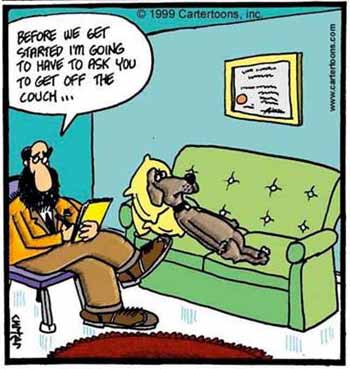
[posted by dinah]
I interrupt this cup of coffee to bring you yet another blog post inspired by an article in this Sunday's New York Times Magazine. This weeks inspirational piece is from The Funny Pages and is called "Celebrity Crazy" by Shalom Auslander. First, let me tell you that this piece won out --for the moment, anyway-- over the magazine story about the severely anorexic teenager, and the Times' ongoing series on diagnostic & treatment issues in severely mentally ill children. Something lighter, I suppose, in honor of the holiday weekend.
So the author seeks psychiatric treatment to deal with his anger issues. He is a reluctant patient and starts his narrative with:
"I'm not doing the couch thing," I said.
"You don't have to do the couch thing," he said.
"Good. Because I'm not."
"That's fine."
"Should I do the couch thing?"
The author's therapy was going well, he reports, until the doctor referenced unnamed celebrity clients as examples of patients with similar issues. Mr. Aushlander liked this. "Cool, I thought, I'm as crazy as a rock star." Unfortunately, he began to see his relationship with his doctor in the shadow of this information. If there wasn't an available appointment on the day he wanted, well clearly he wasn't a colorful enough psychotherapy patient; his therapist was holding those hours for celebrities whom he assume had more exciting issues, perhaps even "heroin-fueled sex orgies." Rather than deal with his transferential feelings of neglect (--you'll forgive me here for making an interpretation on a patient I've never examined, I admit this may be a leap), the patient on the page decides to embellish his own life, to make it as interesting as one lived by the stars. When that doesn't gain the desired response from the therapist, the patient quietly decides to leave therapy.
So he's walking out the door when the shrink invites him to a family picnic in the Hamptons. Dinah-the-reader cringes, but okay, go on. Big party, busloads of people. Photos of the shrink on the wall with the celebrities. Poor Mr. Aushlander. But the shrink hugs him and takes him aside, asking that he be The First to read the book manuscript Dr. Shrink has written about one of the celebrities. Ah, Mr. Aushlander is special after all!! Oh, until he sees that the celebrity, not him, is thanked at the end. Oh well.
An amusing tongue-in-cheek tale, but who doesn't want to feel at least a little bit special to their therapist?
Saturday, November 25, 2006
If Your Doctor Is An Alien
 When my brain comes off holiday you will get a serious post. In the meantime, you get this.
I was at the grocery store this afternoon and as I was checking out I saw this week's copy of Weekly World News. The front page had a picture of three bug-eyed monsters dressed in surgical scrubs complete with masks and caps. The title of the story was:
"Your Doctor May Be An Alien"
I can't speak for my fellow bloggers, but I for one am not an alien. Not that I have anything particular against aliens---I would never require proof of terrestrial origin when hiring someone, nor would I support the idea of building a fence around Earth to keep them out. (After all, we're getting blown up to make way for an intergalactic highway anyway.)
But it did get me thinking about Harvard psychiatrist Dr. John Mack. Although not definitively an extraterrestrial himself, he did write books about alien abductees (now available used on Amazon.com for forty cents). He interviewed many people who claimed to have been abducted by aliens and found that they had experiences in common like being subjected to medical experiments or being forced to breed with aliens. He used hypnosis to regress the abductees and enhance their memories of what happened.
It's interesting to see the parallels between the alien abductee phenomenon and people purported to have multiple personality disorder back in the 1980's. (The abductee phenomenon was a bit later, with Mack's books published in the 1990's.) MPD patients sought treatment for trauma related to organized Satanic ritual abuse. They were treated by therapists who used hypnosis to enhance memory and often reported being forced to breed by cult members. They referred to themselves as cult "brood mares". (I always wondered why no one was ever groomed to be the Satanic cult treasurer.)
I don't know how many of these therapists accepted the trauma history as literal truth and how many used the abductee/Satanic abuse schema as a metaphor in treatment; the more important question is the validity of the treatment that was provided. Alien or not, patients deserve treatment that is not out-of-this-world.
Wednesday, November 22, 2006
From Our Blog To Your Blog

The shrinks at Shrink Rap would like to wish you a
Happy Thanksgiving.
Pictured above is our support turkey, not for consumption.
[From Clink: Yeah, what she said. Happy Thanksgiving!]

Tuesday, November 21, 2006
Flying Kites
Inmates are allowed to put in requests to be seen in sick call clinic and these sick call requests are informally known as "kites". Kite language is typically insistent and rather desparate, written across several lines of the form in big block letters with two or three underlines and exclamation points. In spite of how they sound on paper, when I call the guy down he's usually perfectly normal. Or as normal as you get in prison. It's clear that these guys are used to being in places where they have to embellish their problems in order to get seen.
Once in a rare while I get a sick call slip that sounds pretty benign, only to find the inmate has had a severe clinical depression that went untreated for months at the sending facility. It's challenging to know how to triage these referrals when you have to factor in the magnifier-minimizer effect. The exaggeraters are easy to work with but I worry about the stoic tough guys. They're the ones who quietly stay in the background and won't seek help until they're really really desparate. And then they don't want you to know how desparate they are.
The only thing you can really do is work as quickly as you can and see as many as you can so you don't miss somebody who shouldn't be missed, similar to a paramedic working at the scene of a car crash. And to make sure they have a good enough experience talking to you so that when they do have a serious problem sometime down the road they can feel safe getting in touch with you. A good clinical reputation can go a long way.
The best way to find out where you stand with the inmates is through what I call the "hallway quality assurance program". That's where the inmates hangout in the hallway as a group while waiting for an elevator or waiting to move to somewhere else that they're being herded to. You hear the things that inmates say among themselves and get the 'real scoop' about your reputation. It's an oblique version of Questions For The Doctor----it's Comments About The Doctor. Here's what I overhear about my reputation with inmates (all real and unedited, even the negative ones):
That kind of balances out the leg comments. And by the way, it's all muscle.
Running shoes, not skates
Once in a rare while I get a sick call slip that sounds pretty benign, only to find the inmate has had a severe clinical depression that went untreated for months at the sending facility. It's challenging to know how to triage these referrals when you have to factor in the magnifier-minimizer effect. The exaggeraters are easy to work with but I worry about the stoic tough guys. They're the ones who quietly stay in the background and won't seek help until they're really really desparate. And then they don't want you to know how desparate they are.
The only thing you can really do is work as quickly as you can and see as many as you can so you don't miss somebody who shouldn't be missed, similar to a paramedic working at the scene of a car crash. And to make sure they have a good enough experience talking to you so that when they do have a serious problem sometime down the road they can feel safe getting in touch with you. A good clinical reputation can go a long way.
The best way to find out where you stand with the inmates is through what I call the "hallway quality assurance program". That's where the inmates hangout in the hallway as a group while waiting for an elevator or waiting to move to somewhere else that they're being herded to. You hear the things that inmates say among themselves and get the 'real scoop' about your reputation. It's an oblique version of Questions For The Doctor----it's Comments About The Doctor. Here's what I overhear about my reputation with inmates (all real and unedited, even the negative ones):
- "You gonna see that lady? It's OK, she real nice."
- "I'm here to see the social worker."
- "What a waste. She talks to me for five minutes and tells me I'm OK." (from an inmate irate about not getting sleeping medication. And it wasn't five minutes.)
- "She actually listens to you. She seems to care."
- "She's the only one who does any work around here."
- "Yo, check out those legs. She a speed skater?"
That kind of balances out the leg comments. And by the way, it's all muscle.
Running shoes, not skates
Mass. State Hospitals Blocking New Psych Admissions
I just read that, due to budget cuts and political brinksmanship, the MA state hospital system has to make severe cuts, resulting in them no longer taking any new admissions through the end of the year.
Will where they go if the state is not an option. Is there enough excess bed capacity in Massachusetts? Will the ERs fill up? Will they be transferred out of state or left out in the cold? How will this work?
technorati tags:psychiatric, beds, MA, Massachusetts, hospital, inpatient, emergency, ER
Blogged with Flock
Saturday, November 18, 2006
Medical Director made to resign for speaking up for teen murder suspect stuck in the ER

There's really nothing good about this story at all. But I'm interested in it from the access-to-care angle.
A 16 yo kid in California, two days after being taken to a priest for help with voices, is being accused of beating his mother to death, and was being held in the psychiatric ER for over a week, waiting for an adolescent psych bed for further evaluation. Apparently, no one had been able or willing to take him in on their unit.
The psychiatric unit at Contra Costa Medical Center is reported to only be licensed for adult beds. According to the news article, the unit medical director, Scott Weigold, made a stink about the kid's clinical needs trumping policy constraints. Sounds like he made no secret of his concerns (broadcasting the email to staff), was accused of insubordination (are they in the military?), and is essentially being told to not let the door hit him on his way out.
He e-mailed Dr. Jeff Smith, the hospital's executive director, saying he planned to admit Mantas to the hospital's adult inpatient unit.
"I explained in very ham-fisted and emotional manner, that I was desperate to prevent a young man needing psychiatric hospitalization from being required to live in (psychiatric emergency services) for another week or more," Weigold wrote in a letter distributed to his colleagues this week. "I demanded that potential licensing and regulatory issues ... are not sufficient to prevent us from providing this young man the only form of inpatient treatment available."
[...] Contra Costa acute-care facilities for adolescents accept only people who meet strict criteria for being held against their will, including being gravely disabled by mental illness or posing an acute danger to themselves or others, Smith said.
Contra Costa Regional Medical Center is not licensed to provide inpatient treatment to youths and does not have staff members credentialed to do so, he said.
Smith e-mailed back to Weigold, accusing him of insubordination and stating that he considered the e-mail to be Weigold's resignation.
I don't have much to say about the kid, but I do understand Scott's frustration. We see less burdensome kids in ERs for a week or more around the state. It does sound like he went about making his case in a less-than-effective way. However, I'm guessing that there is more to this story than mentioned here. For example, Contra Costa was in the news last week about closing down nearly half of their psychiatric beds, citing insufficient community need (this hospital is in the San Francisco area). But advocates are crying foul:
[Danville resident and advocate Nancy] Thomas raised questions about a loss of federal money for the psychiatric unit because of a dispute involving the qualifications of people overseeing it.
The Times reported last week that the U.S. Centers for Medicare and Medicaid Services will deny a higher Medicare reimbursement rate for this year, a rate the county has received since at least 1998.
To obtain the higher rate, the federal agency said the director of inpatient psychiatric services should be a psychiatrist -- he is a licensed clinical social worker -- and the unit's nursing director should have a master's degree in psychiatric and mental health nursing or comparable experience in caring for the mentally ill.
"Why would you leave $2.8 million on the table to just slip away?" Thomas asked county officials. "Why not keep those beds open?"
They were also in the news yesterday being accused by CMS of inappropriately transferring uninsured patients with psychiatric problems to other facilities... the article suggests that Scott started that policy. CMS said it would terminate its Medicare contract if the problems did not get fixed soon.
Getting clearer now... Most inpatient units have a medical director; in part, because of the above reason, but also because it just makes good clinical sense to have the person setting the rules be one with full medical training. Apparently, the social worker runs the show. Now, I'm not knocking social workers, but an inpatient unit providing medical treatment and medications should have medical oversight. N'est pas? Perhaps this was merely Scott's last straw.
* * *
BTW, I also note that Scott backed up Dr. A 5 years ago in an exchange on an antipsychiatry site (http://www.antipsychiatry.org/e-mail.htm#debate2). Wonder if it's the Dr. A we all know and love.
technorati tags:psychiatric, hospital, access, CA
Blogged with Flock
Show Your Colors

In prison if you have a gang affiliation it's important to show your colors. For my older inmates---over age 40---that would be grey.
In general older inmates are respected by younger inmates. They make good cellmates because they're not considered a threat and because they may have some good advice to offer. They're quieter and less annoying than young cellmates who are busy yelling to their friends down the tier.
Chronological age and physical age aren't always the same. The street lifestyle can add ten to twenty years to one's physical age. In between the substance abuse, head injuries and HIV dementia there aren't a lot of young neurons in my outpatient clinic.
By policy every inmate is required to have an annual physical. Beyond a certain age they also start screening for dementia with an annual Mini-Mental State Exam. Neurology consults are available and you can also do the basic dementia related laboratory work. Inmates can be sent to outside institutions for brain scans if necessary.
The biggest challenge in carrying for elderly inmates is the need for nursing services. No general population tier has nursing staff to supervise showers, dressing or feeding. Elderly prisoners with mobility impairments are at risk of falling because correctional facilities just aren't built for fall prevention. There are no geri-chairs or vest restraints or non-skid rubber mats in the showers. My most memorable fall-risk example was of an elderly inmate with Parkinson's disease shuffling along in leg irons with untied shoes. It was enough to make a geriatrician cry. (I did make sure his shoes were tied before returning him to the tier.)
Some jurisdictions have options for special parole for elderly prisoners. You usually have to document that the inmate has a six month life expectancy or else is too incapacitated by disease to pose a threat to society. Of course, whenever you do that you run the risk of being wrong. Our most famous case of a wrongful lifespan estimate involved Deidre Farmer, a transgendered inmate with terminal AIDS. (Mr./Ms. Farmer was best known for his role in the landmark Supreme Court case Farmer v. Brennan, which established the mens rea (mental state) standard necessary for a facility to be found "deliberately indifferent".) Farmer was granted a medical parole and promptly went on to get better and commit new identity fraud offenses. He was ultimately apprehended after trying to forge his own death certificate.
So elderly folks with antisocial personalities can still be antisocial; they just do it slower.
Thursday, November 16, 2006
APM 2006: Day 1 - ECT

I thought I'd follow in Clink's footsteps and blog about things I've learned at the conference I am attending. This is the annual meeting for the Academy of Psychosomatic Medicine (APM), which is the organization for C-L (Consultation-Liaison) Psychiatry. (What is that? It essentially involves taking care of folks with other medical problems who also have something going on in the psychiatric area. If you look at this year's program, you get a sense of what we are about.)
Yesterday, I attended a 4-hour seminar on ECT. I don't do ECT, but it is done at my hospital. As Chairman of the department, I thought it was time for a refresher. Donald Malone and Leo Pozuelo presented (both from Cleveland Clinic). So here are some bullet points... (not to be used as medical advice...not warranted to be accurate)
[Ed: Most of us psychiatrists know that memory problems with ECT is a concern and that there is a need for better data, but these folks here focused more on the nuts & bolts of ECT, so I won't get into the memory issues here. There are a couple links in the comments, as well. The above Wikipedia link also has some discussion about this. Thanks, Alison.]
- Schizophrenia is the 2nd most common diagnostic indication for ECT in the US (Major Depression is #1)
- 86% response rate for initial treatment (50% after adequate med trials have failed)
- there are no absolute contraindications for ECT
- mortality risk ~1:10,000 (similar to that of any anesthesia)
- does not increase risk of spontaneous seizures
- common side effects: headache, muscle pain, nausea, same-day amnesia, same-day diminished cognition
- pre-tx with Toradol and 5HT-3 antagonist reduces SFX
Consent issues
- get separate consent for maintenance ECT, as reason is different (prevent relapse, not treatment)
- with maintenance, re-do consent every 6 months or so (some do it every time)
Procedure
- monitor BP, pulse, O2 sat, ECG, EEG, nerve stimulator
- pre-oxygenate w/100% O2, esp w/morbid obesity, respiratory dz
- continue oxygen after stimulus for a bit
- BEWARE dental complications... most common adverse event... use bite block
Cardiac effects
- initial parasympathetic vagal discharge, with stimulus... can get asystole
- followed by increased sympathetic activity during clonic phase of sz
- then recovery phase, which can include both symp and parasymp
- can pre-tx with anticholinergic, like glycopyrolate or atropine
Pre-ECT workup
- check for dental issues
- H&P current
- assess by anesthesiologist & ECT provider
- routine brain and spine imaging not necessary
- CBC, CMP, EKG, HCG
Medical comorbidity
- Post-MI: most do okay; 4-6 wks after MI generally okay; beta-blockade
- CHF: optimize cardiac status before ECT; give all rx in AM w/sips H2O; monitor for incr CHF between tx's; esmolol
- AFib: usually okay; may convert to sinus; ?incr risk if not on AC
- Pacemaker: no need to turn off; do turn off VNS
- Epilepsy: may use flumazenil to decrease sz threshold in pts on chronic benzodiazepines; keep AEDs on board; stack the deck by hyperventilation, etomidate, caffeine
- Parkinson's: ECT may improve motor fn; halve the antiparkinsonian dose (eg, Sinemet); might decr ECT to 2x/wk
- Dementia: 2/3 improved mood; 1/2 improved cognition; electrode placement; 2x/wk; ?hold Aricept vs keep and adjust succinylcholine; may reduce agitation... occ used to treat severe agitation in dementia
- NMS: last line
- MS: no problem
- Pulmonary: may need to intubate w/COPD; take inhalers in AM
- Osteoporosis: use good muscle relaxation; use neurostimulator to assure good relaxation; ?check spine XR
- DM: give half of usual insulin in AM, 2nd half after breakfast; check BS; hold AM insulin if prone to hypoglycemia; usually hold AM oral hypoglycemics
- GERD: pre-tx with H2-blockers
- Glaucoma: use drops in AM; ECT can briefly incr IOP
- Pregnancy: does not typically affect FHT/uterine tone; monitor fetus in high-risk preg; get OB consult
Increased risk
- increased ICP
- aneurysm/AVM
- bad cardiac dz
- recent stroke
- severe pulmonary disease
Relapse after ECT: Sackeim (JAMA 2001)... relapse after ECT = 84% on placebo, 60% on nortriptyline, 39% on nortrip+lithium
* * *
Coming up ... Day 2 ... suicidality ... psychosomatic medicine ... alcohol withdrawal
Blogged with Flock
Wednesday, November 15, 2006
Questions for the Doctor
 [posted by dinah]
I contemplated putting up a post about the most embarrassing questions patients have ever asked, but honestly, I'm too embarrassed to repeat the worst one ( and no, I didn't answer). And I'm not someone who is easily mortified: I will readily admit that I did once show up in clinic wearing my dress inside out, and yes, it was obvious.
So recently, a colleague insisted I was in training with him. I wasn't, in fact, I finished 10 years after he did, and it occurred to me that he thinks I'm 10 years older then I am. Clink says it isn't so: Thank you, Clink. This still wouldn't make me as old as Meryl Streep, whom I look nothing like, but we don't have to go there today.
The day after my time warp with my previously-esteemed colleague, I saw a patient I hadn't seen in a few months. He has a persistent mental illness which limits his life in many respects. He is always pleasant, but always answers my questions with a simple Yes, No, Fine, Okay. He offers little else and I've been unable to learn much about him, though he's seen me in the clinic for many years now. So I asked my patient, as I often do, "Do you have any questions for me?" On this particular day, he asked, "How old are you?" Well, this was a rather sensitive topic given the weird insight the day before that I could be mistaken for someone 10 years older then I am. I responded, "How old do you think I am?" (Please don't tell my former supervisors this, they'll revoke my Boards certification.) Whew: he aged me a few years younger than I am. I answered his question (at this point, why not?) and then he asked, "Do you believe in God?" Okay, I didn't care if he knew how old I was, but enough is enough.
I told the story to Clink, and she responded with one of her own:
So in my clinic this afternoon my inmate patient said to me, "Oh, you're doing Lord of the Rings today.""Huh?" I said."Your dress," he said. "It's like what the elves wore in that movie.""Oh," not knowing what the heck I should say to that. Then I started thinking--yeah, yeah I could get confused with Liv Tyler. Sure, it could happen. At least he was commenting on the dress and not my ears.
And, Roy, what do your patients say about you?
P.S. I can't wait for Fat Doctor's stories.
Subscribe to:
Posts (Atom)