Thursday, August 31, 2006

True Confessions


Fat Doctor asked a question which is analogous to a pop fly to my infield. I'm calling for the ball. The question was: Why do people confess to crimes they didn't commit?

Here's an even better question: Why do people confess to crimes at all?

First, let's cover a little history regarding the making of confessions. In the Middle Ages the law was divided into secular and ecclesiastical law. Church law or ecclesiastical law placed a heavy emphasis on confession as a means of absolution and to restore the offender into church society. In the Twelfth Century it became a requirement of the Roman Catholic church. Later in the Fifteenth Century, with the onset of the Spanish Inquisition, confession became a means of enforcing dogma and to punish deviation from church leadership. (Altogether now all you Monty Python fans: "No one expects the Spanish Inquisition!") On the secular side of things, in 1215 the Magna Carta established the beginnings of the modern judicial system with a requirement for trial by one's peers and the use of judges. In modern times this eventually morphed into modern criminal procedure which included a defendant's right to enter a plea and protection against self-incrimination. Miranda warnings came about as a way of preventing self-incrimination.

(Trust me, this history becomes relevant eventually.)

Now, a little overview of interrogation techniques.

When judicial procedure was first adopted in the Middle Ages the defendant was required to enter a plea to a criminal charge. The plea had to be entered before any prosecution could take place. Not being totally stupid, the criminals did the most logical thing to avoid punishment: they would stay silent and refuse to speak a plea. The courts dealt with this by putting the defendant on the ground and laying stones on his chest until he either entered a plea or died. This is the origin of the modern colloquialism "to press for an answer". There were other interrogation techniques which are best left to the imagination.

In Colonial America the Bill of Rights forbid such things in the Eighth Constitutional Amendment against cruel and unusual punishment. (Note that not everyone was in favor of the Eighth Amendment. When it was being debated the senator from Virginia declared that "brigands deserve to be whipped. Or perhaps to have their ears cut off.") So physical cruelty was out when it came to extracting information from defendants. In modern times police are legally allowed to use just about any means short of physical abuse to interrogate suspects and extract information. Interrogation has become a science in and of itself, to the extent that an Amazon.com book search on the term 'police interrogation' will net you over two thousand results. Eesh. (Interestingly, a search on the term 'civil rights' will net you over 69,000 results. The balance is still in the right direction.)

The best practical man-on-the-street description of a police interrogation I've ever read was in the book Homicide by David Simon, based on actual observed homicide interrogations. This is how he describes the role of the police investigator:
"He becomes a salesman, a huckster as thieving and silver-tongued as any man who ever moved used cars or aluminum siding---more so, in fact, when you consider that he's selling long prison terms to customers who have no genuine need for the product."

(That man can write. You really have to read this book. He's now a writer for the HBO series The Wire, based on the book of the same name written with former homicide detective Ed Burns.)

Investigators, like psychiatrists, learn to establish rapport. They learn to conduct and control an interview. They learn how to collect information and then present it back to the defendant in a way that elicits more information. And they learn tricks---how to lie to a defendant to convince him that it's in his best interests to cooperate, or that his co-defendant has already 'turned' and is ratting him out, or that by confessing others will be protected from full prosecution.
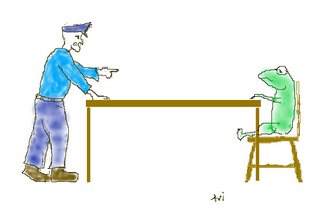
While the investigators are trained and skilled, the defendants are...well...not. You know all those 'dumb criminal' stories you read or hear about in the news? Defendants really are like that. On average, they're not too bright. They use bad judgement. They may be juveniles or mentally ill or in substance withdrawal at the time of the interrogation. These impairments can lower resistance to interrogation. They might have personality traits that make them susceptible to certain interrogation techniques: someone with a need for admiration will be interrogated by using flattery; a dependent person with a desire to please will want the detective to be happy with him. Antisocial folks may enjoy bragging about their crimes---like the serial killer who confesses to a few extra murders just to raise his personal body count. Finally, some criminals really do experience remorse. Confession, in the true historical and religious sense of the term, is a relief to these folks. (See? The history part was relevant.)

So this is why people confess. Phew, I've typed myself out.

Now, for those of you who feel compelled to act on what I've presented here I am providing a link for your own personal online confession site. Trust me, it will go easier for you if you tell everything.

Wednesday, August 30, 2006

The Skewed and The Skewered

Recently Dinah sent me a link to a Chicago Tribune article about a woman with bipolar disorder who was taken into custody by police. Her parents were desparately trying to get her home so she could get treatment, but she was arrested at the airport for creating a disturbance. Eventually she was bailed out, and several hours later she died from a fall from a building. According to the article, while in police custody she screamed and kicked at the bars of the holding cell while shouting "Take me to the hospital. Call my parents." Not surprisingly, the police told her to shut up. My guess is that they probably didn't use those exact words.

The point of this post isn't to comment on this particular story but in general to discuss what happens when the media covers a confrontation between people with mental illness and law enforcement. There have been a number of incidents like this in our state, and the slant given to these stories is completely predictable. I called it 'outcome-based spin'. In other words, the media will take the viewpoint that favors the victim regardless of who the victim is.

Let me give a couple of examples. I have no personal involvement with either of these cases and they are a matter of public record.

The first case involves 84 year old Dotty. Dotty was a retired school teacher with bipolar disorder. She stopped taking her medication and her neighbors called the police when she placed what appeared to be Molotov cocktails on her front lawn. Police arrived on the scene but she refused to answer the door or the telephone. After examining the bottles, the police determined that they were not actually explosive devices. According to the emergency evaluation laws police are only allowed to transport someone for evaluation if they personally observe the dangerous behavior and the dangerousness is imminent. Since she didn't respond to their attempts to contact her, they entered the house to attempt a personal evaluation. She charged the officer brandishing a knife and was shot to death.

In the second case, 34 year old Fred had schizophrenia and had been discharged from his local community mental health center for noncompliance. He had not received his decanoate shot for several months and relapsed. His wife called the police due to his increasingly fearful and erratic behavior. When the police responded and tried to talk to him, he fired a shotgun through the door of his apartment and killed the officer.

Following Dotty's death, which was covered on the front page of the local newspaper, there was a series of articles and letters to the editor about the sad state of the local police department and their insensitivity to mental health issues. There were letters about the officer's use of force and second-guessing about how the situation should have been handled. The emergency evaluation laws were rewritten and the local police commanders participated in a training program to recognize and work with people with mental illness. (Ironically, the office killed in the second scenario was trained and had experience in this area.) Following Fred's incident the outcry was against psychiatric patients, with implications that anyone with a psychiatric disorder was a potential "dangerous nut case" who should be civilly committed.

Thus we have the two angles: the Horrible Police and the Dangerous Nutcase. The spin that is used is determined by who ends up dead. The complete details of the story are either unknown or unrepresented and you almost never see a balanced presentation.

In the case of the Chicago woman (I know, I said I wasn't going to comment on that story...I find I must) let's consider this:

The officer at the scene of the airport, who actually observed the woman and talked to witnesses, made the decision to take her into custody rather than transport her to an emergency room. The woman's own parents apparently felt she was well enough to fly in a commercial airliner. This implies that she was able to contain or conceal her symptoms to some degree. In the police station she was shouting statements that were relevant to the setting and to her situation. She was not shouting about being the Queen of Sheba. If any of you have been around female pretrial detainees, you know that loud shouting and banging is the norm in that setting. Shouting is a non-specific symptom and police are not mental health professionals. If all the person is doing is shouting, it can be difficult to say if the person is intoxicated, psychotic or just really really pissed off.

Obviously, the actual facts of this case will get sorted out in the course of the lawsuit. I just thought I'd bring it up as a reminder that the facts that get presented in the media are the facts that will sell the newspaper and attract eyeballs to the TV or web site. Sensationalism sells, and the more tragic the victim the better.

Tuesday, August 29, 2006

What People Talk About In Therapy


[posted by dinah; part 3 in a multi-part series on psychotherapy]

This post was inspired by Carrie's post "You're Not At That Point Yet" from NeoNurseChic.


In my past ramblings on psychotherapy, I made the comment that sometimes people seem to talk about trivial things that happen in their lives --I think I used the comparative price of beef as my confabulated example for my confabulated patient-- and they still find therapy helpful. I noted that therapy can work even if the patient doesn't come every week: help is where you find it and people have different needs and extract comfort & cure in different ways.

Psychotherapy is a private endeavor, it happens behind closed doors with an intimacy-- secrecy, even-- that makes it difficult to learn and difficult to teach. It's a process that occurs over time, sometimes a lot of time, and it can be difficult to describe to a student what is to be done and how. What does the patient do that makes psychotherapy different than a conversation with a friend and what does a therapist say that effects healing?

Some patients walk in the door and they know just what to do. Maybe they've been in therapy before, maybe they've watched the right movies. Other answer questions and aren't predisposed to talking about their lives in detail. Some worry about what they discuss, others simply recount the events of their week, and some simply struggle.

I've taken to giving patients fairly specific instructions about what I want to hear, what I think will be helpful to them: I want to hear about the meaningful things that have happened in their lives since we last met. Nothing huge should be going on that's left unmentioned. People tend to write their own stories for why they do what they do and how they got to be who they are, so if the events they talk about bring up memories of the past, I want to hear about the past. If they're not thinking about their childhood, I'm not particularly interested in having patients unearth random events from long ago. Psychoanalysts may feel differently about long-forgotten memories, but I'm not sure what to do with them unless they have some relevance or hold on the present.

I like to hear about people's lives with he-said-she-said detail that puts me in the room. So if I'm told, "we had a fight," that doesn't cut it. I want to know the details of the fight, who started it, who said (or threw) what, the mitigating factors, and how it resolved. I'm not so interested in after-the-fact interpretations, I want to hear the evidence. So if a patient says "My mother uses me to make herself feel good," I follow up with "Can you give me an example?" I may well reach the same conclusion (...yup, your husband mistreats you...or whatever), but I like to get there myself.

Mostly, I listen. Often, I ask for more detail, or I find something interesting or important sounding, and will guide the conversation down a certain path. Sometimes, I'm there to offer hope and reassurance. I say, "You're going to feel better," a lot. Seven times today to three different patients--everyone else already felt better! Most people get better, almost everyone feels at least a little better, and no one (yet? I don't want to jinx myself) has ever come back and called me a liar.

Psychotherapy is often about finding and elucidating patterns for people. Have you noticed you always feel badly at this time of year? That you've been feeling worse since we stopped the medicine? How you talk about your boss the same way you talk about your mom? How you make assumptions about the reactions of strangers that keep you from even trying to get what you want? Maybe it resonates, maybe it doesn't, I can always try again.

Psychotherapy is often about pointing out things that would be difficult or painful to hear in ordinary conversation. Something about the setting makes it safe to hear hard things, to learn about oneself in a way that enables the patient to effect change.

Many books and articles have been written about psychotherapy; it's hard to imagine that I have anything new to add to all that's been said. It's fun to write about, however, so thanks for listening!


Free Food For Thought

A colleague of mine walked into my office today and handed me a slip of paper with the URL for a great resource that I thought I'd share with our readers: Free Medical Journals is a metasearch engine that links to major medical publishers offering free full-texts of their articles. It covers all the medical specialties as well as some non-medical journals for psychologists. You can also sign up for the free email subscription service and have summaries of selected journals sent to you on a weekly basis. For a list of available psychiatry and psychology journals, follow this link.

Monday, August 28, 2006

Runner's Anonymous

While Dinah was busy calling Camel, I was thinking about calling a taxi. I was also thinking about traumatized capillaries, hemoglobinuria, rhabdomyolysis, dehydration and acute renal failure. And I was having a great time.

The temperature was warm but not hot, the sky was overcast and at the eighth mile of my ten mile run the perfect breeze kicked in. My breathing was comfortable, my joints weren't too bad and I was starting to pass people. It struck me that there was no apparent correlation between body habitus and speed---I passed someone built like a greyhound but for most of the race I slogged behind a couple of hefty women keeping a steady pace. These are the folks the sports medicine docs call the 'fit fat', people in good physical condition who nonetheless are overweight. These women finished the race. Anyway, I finished with enough energy to put on a good sprint for the last several yards into the finishing shoot. The crowd cheered me on and it was terrific.

As I said, I was thinking about calling a taxi but my ride was waiting for me at the end after finishing about five minutes ahead of me.

I'm posting this because some folks have wondered what psychiatrists do for stress. I highly recommend regular, comfortable exercise with a friend. It's good for heart and the social life when you have someone you can vent to as you jog. Or just shoot the breeze.

For those of you thinking '"I could never do that" I say: You don't have to. In fact, to start an exercise habit you don't have to exercise at all. Don't buy running shoes or sports gear, don't invest in a gym membership, don't pay a personal trainer. Call a friend or two or three. Have enough people on your 'exercise partner' list that one or two will be available to get together. Start out two or three times a week, going for a walk or a bike ride. Do it comfortably so you can talk the whole way. Do not go out for coffee afterward! Give yourself permission to skip it once in a while without beating yourself up; just get back into it the next week. Once you get used to working it into your schedule you can then start working on intensity. Listen to your body and rest if you're in pain. If you're in pain consistently change your workout or see your doctor.

I'm pretty much recovered from my ten mile race, after a hot soak in the shower and a nap. One more notch in the twelve step recovery program for couch potatoes.

Sunday, August 27, 2006

Group Therapy (sort of)

[posted by dinah, with guest barkers max, tex, and alfie]

Max has a new buddie, Alfie, a chocolate lab who is currently in foster care with Tex and family while she awaits transport to her permanent home in Georgia. Alfie, in her pink, rhinestone-studded collar, makes quite the statement. My only psychiatric observation is that she plays well with others and, as a group, this gang is not prone to introspection. The biscuits are what it's about and surely, the end justifies the means. Not really psychiatry, but who can resist a new puppy?

Saturday, August 26, 2006

Everyone Needs A Camel

"Hey, honey, you'll never guess who came into the office today!"

These are words a psychiatrist never says. *

The work we do is dressed in secrecy, mandated by a need to preserve patient confidentiality: started by Hippocrates, finished by HIPAA, and filled in in the middle by a need to be certain that the shameful (or not) drippings of one's fantasies and the guilty (or not) remnants of one's misbehaviors have a safe outlet which won't come back to bite.

But, at the end of the day, what about the psychiatrist ? How many blanks can we leave in our stories?-- For surely we're human, too, with some need to talk about our lives, and our days are filled with stories-- often fascinating stories-- we can't repeat. Really, we can't even write blog posts without confabulating our patients beyond recognition. It's a border we can't even get close to. What if we're upset by an interaction, want a suggestion on how to handle a difficult situation, want counsel as to what to do next with a complex medication issue? Or what if we just want to be heard? Of course, we can seek formal consulation or supervision, but what about the day-to-day stuff?

Years ago (we won't go into how many: enough), I worked in a clinic with another fresh-out-of-residency psychiatrist who also had a new baby. Just in case it's not enough to be a new shrinks starting together at the same institution, parenting issues were an instant form of bonding. And this psychiatrist's baby was (and remains) a constant source of enchanting stories. Eventually, we both left the clinic, and she relocated to another area code. Our friendship, however, remained fixed, and through an assortment of associations my friend has somehow acquired the nickname "Camel." So that we're clear, this is not a reflection of her physique.

Camel is often my go-to person. When a child (generally my own) says or does something that taxes the limits of my self-control, I call Camel-- she's on speed dial and she often can provide empathizing stories. When something good or bad happens in my life, I call Camel. When I need a support psychiatrist to fly to psychiatric conferences with, I take a Camel. She's better than a duck and almost as good as a goat. When I win the lottery, I will call Camel. When I need a friend to have a drink with...well, sometimes, the distant area code thing gets in the way so I have local friends for such emergencies.

Camel is also my first stop for Curbside Consults. She knows a lot about medications and is kind about my ranting. ClinkShrink, while my first stop for all matters forensic, doesn't Do psychotherapy, and whenever I ask her about her experience with any medication patented after 1973, she says "we don't have that in jail." Camel keeps up-to-date and remains an invaluable resource, friendly ear, and the origin of many entertaining stories.

* I put an asterik here because, really, I have no idea what psychiatrists tell their spouses. I never divulge the names or identifying information about any of my patients to either my spouse or my camel. Unlike the blog, however, I don't go as far as to confabulate new information to create a hypothetical scenario.

Happy Birthday, Camel.

Tuesday, August 22, 2006

What Makes It Therapy?


[posted by dinah, part 2 in a multi-part series on psychotherapy]

In my Talk Therapy post, I rambled (who me, ramble? never!) about my ideas regarding the purpose and process of psychotherapy. I noted that patients sometimes spend their sessions discussing the day-to-events in their lives, sometimes they discuss seemingly trivial affairs, sometimes they remain mostly silent, and still they feel some benefit. If you look at that post, you must read the comments: insights from both psychotherapists and patients; I especially loved Nutty's story of the newly widowed man who called at night to talk about soccer.

ClinkShrink, in her Couch Time post, tells us she treats prisoners with medications, "I treat brain diseases." She doesn't DO psychotherapy.

It leaves me with the question: what IS psychotherapy?

I think, with the help of the late Dr. Jerome Frank (Persuasion and Healing), we've agreed that it helps (or is crucial) if the therapist is warm and empathizes.

In my mind, if I meet with a patient weekly for a 50 minutes session and we both call it psychotherapy, then regardless of what gets discussed, it is, by definition, psychotherapy. As I said in the Talk Therapy post, people mostly seem to get better regardless of what they discuss-- whether "better" means a cessation or reduction of psychiatric symptoms, increased insight, personal growth, comfort in the sense that they are understood and less alone in the world, relief at unburdening/ventilating troubling past events or feelings, or simply maintaining a status quo-- a "holding" state.

But does the interaction have to be for 50 minutes every week?
In fact, I don't see very many patients for weekly psychotherapy for the long haul. It's expensive and time-consuming. People-- with some exceptions of course-- come weekly for a while, perhaps a few months to a year or a little longer, until they feel better. Even if they want to continue therapy-- there's more to work on or perhaps they're afraid of losing the gains they've made-- they often want to come less often, either every other week, or once a month, sometimes even less. And some patients only come for a half hour, they just don't have much to say, but the contact remains helpful. And, with time, I'm finally convinced that how frequently one comes doesn't dictate how much change can be made, some people do an awful lot with a few sessions or with spaced sessions. And some people do better with less than with more: it's as though limiting the therapy gives it more power.

People change, if you believe that they do, for reasons aside from psychotherapy. Maybe it's the medicines. Maybe it's the change in season. Maybe it's that the evil boss got fired and is no longer a source of daily aggrevation. Maybe it's a streak of Good Hair Days . And people are impacted all the time in ways they feel Change their lives. Who hasn't read a book or seen a show that changed the way they view the world? Who hasn't quoted a teacher or a friend who said something wise that resonated, that helped explain something important?

During the weeks I worked in post-Katrina Louisiana, we were left to ask this question often: we were used to seeing patients over time, how could we make an impact, how could we help, seeing someone once or twice? We listened, we prescribed medications as we could, and we tried to impart a bit of hope on a place so badly in need.

People expect psychiatrists to listen. Patients gain comfort from being considered, and sometimes they find tremendous relief from simply being heard, or from getting the feedback that their responses are normal. Sometimes there's comfort and hope in learning a diagnosis. It's hard to sift out what makes a session just about medications, and not about therapy, unless the patient is only permitted to discuss symptoms (Are you hearing voices? How is your sleep and appetite? How is your mood? Are you thinking of suicide?). Presuming that at least a little bit of most encounters entails letting the patient talk about how they are and what is going on in their lives, presuming the psychiatrist doesn't re-direct them from giving any other information-- though I imagine that is what happens in 5-10 minute med checks where there can't be enough time for much else-- then I suppose most encounters have the possibility at least to be therapeutic in a way that has more meaning then pharmacologic maneuvering.
And sometimes even brief encounters can herald big insights and big changes.

My best guess is that ClinkShrink really does do a bit of therapy. If nothing else, she listens to me.

Guinea Pigs Behind Bars

Most psychiatrists know the story of how lithium was discovered, but for the rest of you here's the story:

Many years ago a fellow by the name of John Cade decided to give lithium to manic patients because he noticed that the substance seemed to calm agitated guinea pigs. (Don't ask me how he could tell the guinea pigs were agitated. As far as I can tell all guinea pigs do is squeak and munch alfalfa pellets, or occasionally chuckle while peeing on the visitor's lap but that's a story for another day.) Anyway, the lithium worked.

In the early '70's lithium was tried on another group of research subjects---prisoners with a history of violence. Researchers found that lithium cut the rate of violent infractions in half---even when the inmates didn't think the medication was working.

But the point of this post isn't specifically about lithium---we already have a nice post about that (Peace and Lithium). The topic of this post is clinical research on prisoners.

When this topic comes up most people have an immediate association to Josef Mengele and other horrors. However in the United States physicians had been doing research on prisoners for at least twenty years before that. In one study done in 1916 inmates on a prison farm were used to study pellagra, a disease caused by a nutritional deficiency of Vitamin B. In exchange for a full pardon they were placed on a four month diet entirely free of Vitamin B. By the end of the study half of them had developed dermatitis, weight loss, loss of strength and nervous system impairments.

By 1948 as a result of the Nuremberg trial America developed the earliest standards for human research on prisoners. Dr. Andrew Ivy, a prosecution expert at Nuremberg, proposed that medical research should be allowed if results were "unprocurable by other methods" and animal experimentation had already been performed. He also suggested that medical personel should serve as subjects along with volunteer prisoners. Although he recognized the potentially coercive influence of pardons or "good time" credit, he fell short of banning it outright as an incentive for participation.

At one time a central issue in correctional research was whether or not inmates truly had the capacity to give informed consent. The nature of the correctional environment was thought to be too coercive for completely voluntary consent given the lack of contact with advocates (including friends and family) or other counsel. Today this is not the prevailing opinion and inmates routinely give informed consent for treatment or research.

Presently correctional research is governed by the Code of Federal Regulations, Subpart C, entitled Additional Protections Pertaining to Biomedical and Behavioral Research Involving Prisoners As Subjects. These regulations permit research on prisoners if it falls within certain guidelines. The research must not give the subject advantages or opportunities within the prison to the extent that the offered reward would impair his ability to weigh the risks of the research. Subject selection must be impartial and free from influence by prison officials. Correctional research is allowed if it involves the study of the causes and effects of incarceration or criminal behavior, or conditions which affect prisoners as a class such as hepatitis or drug addiction. It is also allowed if it involves practices which have a reasonable probability of improving the health and well-being of the individual. All studies require that the research involve no more than minimal risk or inconvience to the inmate and that the decision to participate should not affect eligibility for parole or parole decisions. As with any human research, the study must be approved by an Institutional Review Board.

Now a New York Times article discusses a proposal to loosen Federal regulations for the use of prisoners in clinical drug trials. The proposal has the backing of a consortium of prison advocates, researchers, correctional staff and ex-offenders. Even the ACLU has signed on. But is this a good thing? Read the full story for the viewpoint of ex-research subject-prisoners. Be sure to watch the six minute video clip about the history of prisoner research in one Pennsylvania facility.

**********

You wouldn't believe how long it took to find this guinea pig picture. Along the way I found an unfortunate number of photos of guinea pigs as...umm...food. With apologies to our South American readers: yuck. Then I found this site with guinea pigs dressed in little costumes. How humiliating. Which would I prefer if I were a guinea pig?

Pass the parmesian.

Monday, August 21, 2006

Hot Potatoes

Roy sent me a backchannel link about a clinical dilemma involving an inmate. At the time I dashed off a quick email response and didn't think too much about it. As coincidence would have it, I got a call this morning asking for advice about an almost identical situation. Fate has destined me to write about the topic of hot-potato patients, patients whose disposition is fraught with controversy.

The basic facts of the clinical scenario, for those of you who don't feel like following the link, are that a psychiatric patient gets charged with assault for attacking a staff member. He gets sent to jail, where he throws urine on a nurse bringing him his medication. His public defender goes to court and tries to get the man transferred back to the same mental health center where the assault took place, alleging that in jail the defendant is not getting the psychiatric treatment he needs. The judge agreed that the inmate "needed to be in a mental facility immediately if not sooner" and mourned the fact that he didn't have the authority to arrange this.

The problem with situations like this is that discussions usually deteriorate into arguments over diagnosis (eg. "He 'just' has a personality disorder.") or social policy (eg. "People with mental illnesses shouldn't be locked up."). While these issues are important---particularly considering the information presented by Roy about the lack of psychiatric beds---they are irrelevant to solving the current dilemma. The focus needs to stay on the clinical needs of the prisoner-patient.

Security is a component of any treatment plan, a fact that free society care-providers sometimes forget. Even outpatient clinics need to have a security system and a plan for implementing it. Inpatient units must have security procedures. Each individual patient may require security either for their protection or for the safety of those around them. The security needs of this patient-prisoner need to be addressed along with his therapeutic needs.

So let's see what this patient needs:

Obviously he needs a locked facility from which he cannot escape or elope. Correctional facilities can provide this, but an inpatient psychiatric unit may not be able to. Even locked units don't always have the 'sally-port' component to make them truly escape-proof.

The second need is for an isolation room within the facility. A patient who assaults others must be kept secluded, either in a segregation cell or in an inpatient seclusion room. Both the correctional and the mental health system can provide this, but inpatient units generally only have one or two of them while correctional facilities have more.

One-to-one observation may or may not be required, depending on the clinician's assessment. Mental health facilites are more likely to be able to provide this than correctional facilities, although there will be a lot of variability depending upon the size of the correctional facility. Smaller facilites may only provide fifteen minute checks because they have too few staff members available to do continuous observation.

Emergency medication can be provided either in jail or in the hospital, but only on a time-limited basis if the patient is imminently dangerous. If longer-term involuntary treatment is needed, the legal procedures for doing this usually must take place in a hospital. If the correctional facility doesn't have a psych infirmary, the staff may not have enough experience doing involuntary medication to handle this situation.

Finally, when the prisoner-patient is ready to start coming out of seclusion, there must be enough security attendants to supervise him and the unit should also have some type of walking restraints available. Non-forensic hospitals usually don't have these kind of resources. Correctional facilities can do this easily with handcuffs, waist-chains and leg irons. Face shields or spit-guards are handy too.

So let's see how the factors add up:

CharacteristicJailBothHospital
Escape-resistantX  
Isolation room X 
Observation X 
Walking restraintsX  
Security attendantsX  
Emergency medication  X
Involuntary medication  X


It's a close call. The thing to keep in mind is that the needs of the patient and the resources of each facility are going to change over time. The patient (hopefully) will get better and need less. The facility may have an unexpected event (eg. several acute patients at once) and have fewer resources available. This table doesn't give the absolute answer to all disposition questions but hopefully it will provide some guidance for the discussion.

Sunday, August 20, 2006

Shiny Happy Hair Scale


I understand that ShrinkRap owes Shiny Happy Person a fair amount of money for the great idea of a hair-related mood scale. Well, here it is. In lieu of royalties I am offering this ready-to-use instrument for all those affective disorder researchers out there.

The hair scale is based in part on the Homeland Security threat levels. The lowest threat level has a blue color code and is represented by Miss Piggy with her luxurious, extravagant looping curls. Miss Piggy is in a great mood, as illustrated by her motto "I Rule!". The neutral threat level is yellow and is represented by a quizzical, placid monkey with gentle wisps of hairy optimism. He is euthymic and accepting: "I'm OK, You're OK". The highest threat level, the red level, is shown by Frizzled Cat. Frizzled Cat has been dunked in a vat of flea dip and and blow-dried to maximum intensity. Frizzled Cat will attack with little or no provocation. Don't even think about stopping to schmooze.

Women everywhere can now warn their husbands and boyfriends what to expect just by slapping one of these on their foreheads. Or wear it to work to warn away those annoying co-workers that it's time to go back to their cublicles.

Then I started thinking...I do this occasionally.

Wouldn't something like this be a great way to assess mood in preverbal children? After all, children learn to recognize faces and identify emotions long before they can put a name to them. Max is pretty good at identifying human emotions and he can't even talk much less write a novel. All we need is a nice range of simple iconic human facial expressions and we're set to do research in children's affective disorders. It would be much easier than the Kiddie-SADS. Then again, it's such a good idea it's probably already been done.

That got me thinking again. Twice in one day...I'm on a roll...

Why stop at preverbal children? If it's good to catch the disease process as early as possible, why not neonatal mood scales? The Shiny Happy Hair Scale has relevance here---I can see the NICU progress notes now: "S: 'Goo goo wah...' O: Patient has full head of wavy curls. A: Incipient mania P: Start lithium". I can see this incorporated into the Apgar score at birth. But again, why stop there? With digital video and facial recognition technology, why not search for in utero pathology on ultrasound? The Shiny Happy Hair Scale applied prenatally.

OK, so now I'm being facetious. This silly post is actually grounded in a serious point: At what point does an attempt at early disease recognition, particularly as it pertains to mental disorders, become impossible to validate? Without gold standard diagnostic technology we become increasingly reliant on external interpretation of subjective internal phenomena without any way of verifying these observations with the subjects themselves.

It's tough enough knowing what Max wants; I'm not even going to guess about that kid on the ultrasound.

Saturday, August 19, 2006

[Roy] Where have all the psych beds gone?


Since the deinstitutionalization movement in the 1950s and 60s, the number of psychiatric beds in the US has been dropping, coinciding with the psychopharm era, the community mental health center era, and then the managed care era.

There used to be 20.4 public and private psychiatric beds per 10,000 population in the US in 1970, and now there are only around 3.6, a drop of 82%. This compares to 465 general med-surg beds per 10,000 population in 1975, with a current staffed capacity of around 229 (51% drop). In 2003, 5.8% of folks admitted to hospitals from an ER were for mental health and substance abuse problems.

The definition of a "medically necessary" admission has been so eroded that currently you pretty much have to threaten suicide to gain inpatient psychiatric hospitalization. The result of these changes is an inadequate supply of both inpatient psychiatric beds and of community alternatives.

The ongoing debate is whether to invest money in more psychiatric beds or into community services which can prevent the need for the beds in the first place. While the debates continue, patients pile up in Emergency Departments (ED) throughout the country, waiting for a bed to open up somewhere in the state. In Maryland, it is not uncommon for folks to wait in an ED for 3-5 days before being transferred out. It is particularly problematic for kids, seniors, developmentally disabled folks, and the uninsured.

In Louisiana, their previous shortage has grown worse since Katrina, resulting in serious backups in the ED.
Times-Picayune: "The problem is not confined to the New Orleans area. Joseph Miciotto, administrator of the LSU Hospital in Shreveport, said the emergency room there has had up to 21 psychiatric patients awaiting admission at the same time, creating potential safety problems for patients and health workers."
USA Today: "And estimates also suggest that only 22 of 196 psychiatrists continue to practice in New Orleans, while the number of psychiatric hospital beds has been sharply reduced: as of June 14, the authors said, there were only two psychiatric beds within a 25-mile radius of New Orleans."

I have noted a reversal of this trend in the last few years. States are starting to add beds, mostly because of outcries from mental health advocates about long waits in EDs.
Kansas City Nursing News: "Over the last 15 years, the number of adult psychiatric beds has steadily decreased in the Kansas City area. Today, there are about 450 beds in the community, a 65 percent decrease from 1990. Based on national and regional data, the Kansas City area should have 600 psychiatric beds."

If you have info to share about what is happening in your state, we welcome your comments.

[Roy] When Worlds Collide


Here's an interesting thread that got me thinking along the same lines as that New Yorker cartoon with two dogs and one is saying, "In cyberspace, no one knows your a dog." Over on BigFatBlog I read this discussion about a brouhaha over at KevinMD about some extremely disparaging remarks about obese people which were written in the comments to the post.

These were pretty nasty comments, such as "monstrous layers of blubber", "some lardo whale that makes Jaba the Hut look svelte", and "most of these patients belong in a zoo...they're animals and deserve to be treated as such." Many of these were anonymous posters being a-holes, but apparently one of them was a physician according to the screenname.

Here's where the point of my post picks up. The BFB comments note that someone (jmars) did some googling and discovered that one of the docs who made some of the comments was a respected physician at the University of Kentucky, Dr Coupal.

Here's where it gets interesting for the blogosphere. Someone called his real-world employer and lodged a complaint against him, triggering a disciplinary action.

I'll say this again.

One "anonymous" blogger called another "not-so-anonymous" blogger's employer and complained that he made unprofessional comments on a blog, resulting in an apology and an explanation (that the comments were taken out of context).

Wow! What I find fascinating is that, at least how I see it, bloggers are essentially disembodied eponym's, not necessarily having anything to do with the actual person typing in the text. Some bloggers are even actresses who are paid to blog from a particular perspective (eg, someone who is lonely, sexy, and just loves Smirnoff Ice). So I see bloggers as sort of alters for a kind of wired, multiple-personality, real person which permits one to express different points of view, attributable to different pen names, so to speak.

We've discussed before (I think FatDoc blogged on this recently) about how disorienting it is when the blogosphere unexpectedly intrudes into our real life (RL). Should we assume that what we read in one's blog truly represents the individual writing it? If not, should we hold them accountable for extreme views -- and do we hold the RL person accountable, or just the blogging persona?

It's kind of a dream world, where we expect blogs to maybe reflect RL, but that the blogosphere (BoS) is not really "real". Kind of like the online "game", Second Life, where one can buy a house, purchase clothes, and even have cybersex... even using RL money to buy these things. Most folks don't expect to run into that avatar you met last night at the Starbucks down the (RL) street.

Here's a Clinkshrink example, that illustrates the confusion that results when BoS & RL collide. Clink will occasionally write a post with perhaps some political undertones (::gasp::). These posts (such as Undisclosed Locations and Officer Down) have disclaimers... you know... like "my views do not reflect those of my employer", etc. Why bother with that? Does her employer really know that ClinkShrink is actually Betty Beavis, MD, of 123 Castanoga Street, in Denver, Colorado (oops!)? Do our fair readers know at which Clink she Shrinks?

It's not necessary, but there's that glimmer of "what if someone finds out" in the back of our blogging minds. Perhaps it is that small thrill, that little bit of anticipatory excitement of discovery that partially drives anonymized bloggers. Wonder what happens to their blogging once they are outed. Probably pick up another alias to use.

Friday, August 18, 2006

Calling Back...


I like to think that as rapping shrinks go, I am reasonably accessible. My office line is a cell phone-- "it goes where I go"-- and just in case, I give patients my home phone number. There are times I'm completely unreachable: I turn the phone off during sessions, when I'm at the movies, on airplanes, and when I sleep at night (ah, that's why folks have my home number). If I'm somewhere I can't talk privately, I let the phone ring through to voicemail and I listen to the message soon after. Anything urgent, I return right away; I generally return all calls by the end of the day, and most of my messages have to do with scheduling or rescheduling appointments.

Anything urgent I return right away. I said that already. It leaves the question of what is urgent and how one defines this. Shiny Happy Person--my favorite shrink blogger across the pond where things seem to work a little differently and people say things like "bugger all"-- likes to run polls about the odd things nurses call to request of her. GirlMD likes to blog about the silly phone calls she gets in the pediatric ER. The tone of both bloggers is one of frustration, even annoyance, and may I borrow a little of that for this post? Please forgive me, even (or especially?) psychiatrists can have trying moments.

So confabulated patient calls last week-- her sister is in an awful bind with her boyfriend. She needs my advise on what sister should say to fix this awful affair. The message ends with "Call me ASAP."

I don't call back. But it nags at me all day. She's my patient and she wants me to call back. The request, however, seems so unreasonable, that I don't. She calls again, "Call me ASAP, my sister needs your suggestions." I can't take it. I call back, happy to get a machine, and leave a message saying something to the effect of I've never met your sister, I've never met her boyfriend, and I have no idea what she should say to fix the problem.

I will add that I'd gotten a similar call from another patient the week before with a similar request to help a friend who was being actively threatened by a untreated mentally ill spouse: in this case I did call back and tell her what agencies could offer help. I refused to speak with the friend, however, but I told my patient what avenues the friend could take.

It's Friday night. The phone rings, I let it go to voicemail and check it. I've run some labs on a patient, I've told him I'll call if there are any problems, otherwise he should assume they are normal (there's no reason they wouldn't be, and hey, this is a confabulated story) and I'll discuss them with him next session. His message says he wants to know what his blood sugar was. It was normal, I don't remember the exact value; I remember it was normal. He wants me to call him back (he doesn't say urgently, but my understanding is he feels this can't wait until Tuesday's session). He's not diabetic, he's never been diabetic, he's never worried about being diabetic or hypoglycemic, and I don't feel like being obligated on a weekend. It is more, I know, with this particular patient, about the connection than it is about the lab value.

I didn't call him back. While mostly I like that patients sometimes get comfort from our interactions, sometimes feeling so needed is a bit overwhelming. Sometimes I'd like to be just a little less connected, especially on a Friday night.

Thursday, August 17, 2006

Transference To The Blog, Once Removed

Subtitled: My Family and Shrink Rap


Pre-Teeny Bopper Daughter
Looks over my shoulder, sees I'm checking E-Mail and says,
"At least you're not Blogging!"

Husband
Sitting at Ravens game, he attempts to explain each play to me (I know we root for the guys in purple, what else matters?) Thinking this must be work for him, I say "You don't have to explain every play to me."
Husband replies, "I want you to be well-rounded and I read the damn blog."

Teenage Son
"What's for dinner?"
As long as I cook, he doesn't care what I do.

Max
Reportedly is pleased to have been featured. And he never complains.

And to my non-shrink Brother who actually Subscribes to the blog:
Hi, Boy-Boy!